Practice method
Calligraphy improves when practice is specific. Crartrask organises each session around a warm-up, a focused construction task, and a diagnostic review of what the hand actually produced.
Drill, construct, diagnose
A session begins with a short stroke drill — the same movements, repeated, until the hand settles. This is not decoration; it is preparation so that later letter work is not fighting an unsteady grip or irregular pressure.
The middle of the session is construction. A letter or a short word is built from numbered strokes, then written freehand. The learner is asked to notice where the model and the freehand version diverge.
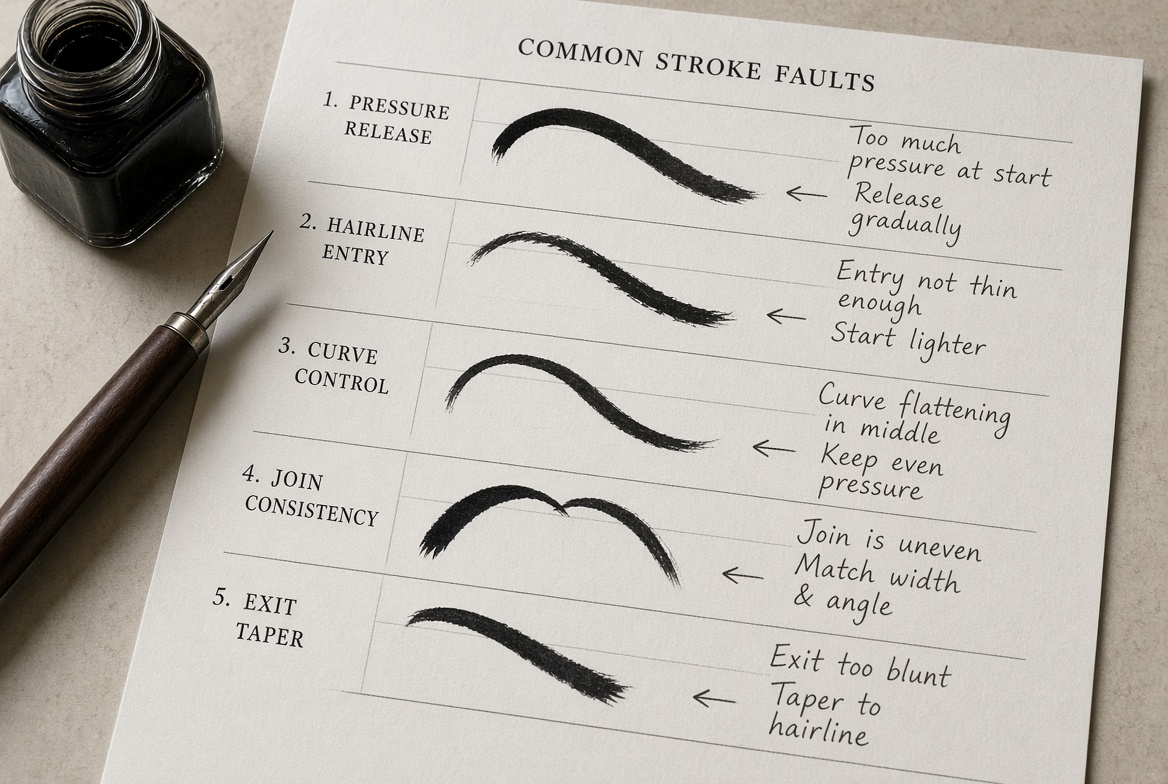
The session ends with diagnosis. A checklist names concrete faults. The learner marks which ones appear on the current sheet. Correction is then limited to one or two faults on the next attempt, rather than a vague intention to “do better.”
Session sequence
Choose a practice area
Beginners start with stroke control. Those with some experience may begin with minuscule forms or a diagnostic review of existing work. Areas can be revisited; the materials are designed for repetition.
Warm up with isolated strokes
Five to fifteen minutes of pure movement: verticals, curves, entries and exits. The aim is even pressure and a predictable exit, not a finished letter.
Work a construction sheet
Follow the numbered strokes for one letter group or one short layout problem. Then write the same forms freehand on a clean sheet.
Diagnose against the checklist
Compare the freehand sheet with the fault models. Mark pressure dumps, blunt exits, uneven counters, or spacing problems. Keep the marked sheet; it is more useful than a discarded “failure.”
Correct one fault at a time
The next short drill targets only the faults you marked. Trying to fix everything at once usually produces new inconsistencies.
What to expect from the method
Visible progress in control
After several sessions, stroke width and exit quality become more consistent. Letters may still look imperfect; the hand, however, is less erratic.
A vocabulary for faults
You learn to name problems (flattened curve, blunt exit, uneven join) instead of judging the whole piece as simply “bad.”
No performance claims
The method does not claim that practice will produce professional commissions or a recognisable personal style within a fixed number of weeks.
What the studio does not provide
- Live one-to-one tutoring as a standard offering
- Certificates that guarantee commercial work or employment
- Commission placement or client referrals
- Product endorsement of specific pens, inks or papers
- Promises about speed of progress or finished style
Those services sit outside the educational scope of Crartrask. The studio exists to organise practice, not to manage careers or sell tools.
Pacing
Most learners work one or two sessions per week. Faster schedules are possible; the materials do not expire. A realistic session is long enough for a warm-up, a focused task, and a quiet review — usually between 40 and 70 minutes. Short daily drills of 15 minutes help maintain stroke control between longer sessions.