Educational practice only. These materials teach technique. They do not train commercial lettering for hire, and completion does not constitute a professional credential.
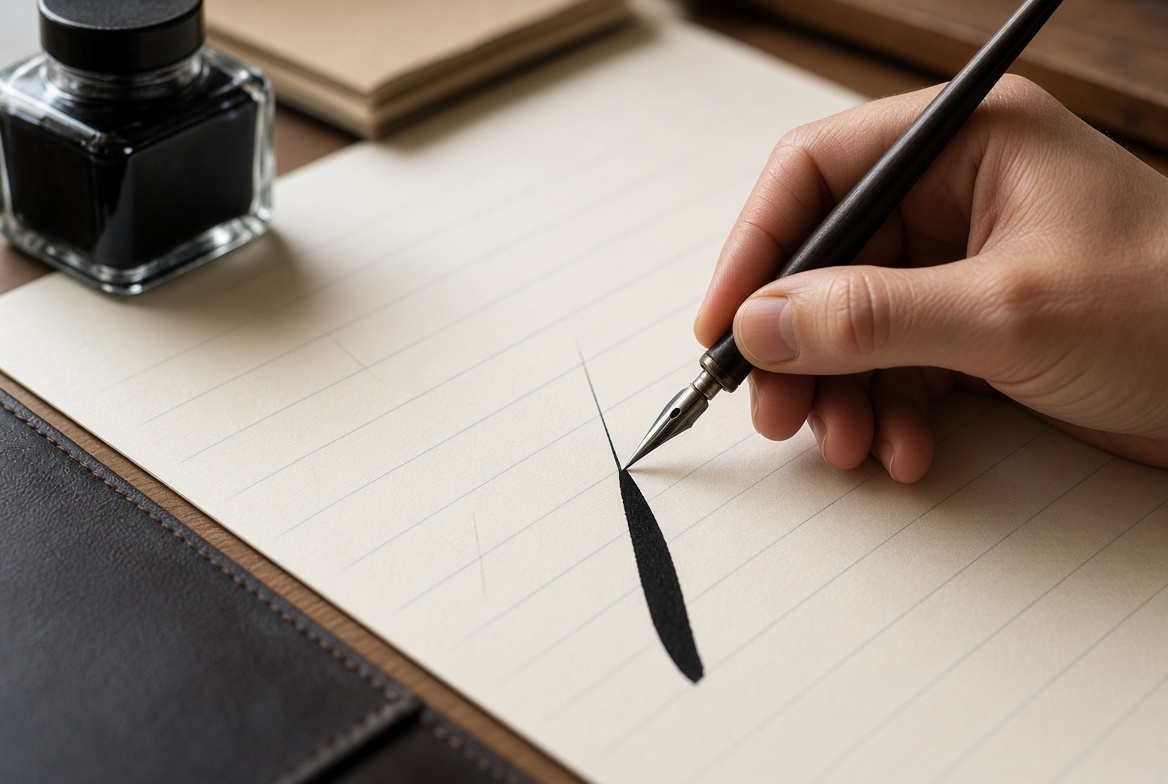
Pointed nib making a controlled vertical downstroke on practice paper

Foundation · Sessions 40–60 min

01 — Stroke control

Before letters exist as shapes, they exist as controlled movements of the nib. This area isolates entry, pressure, release, and exit so that each can be practised without the distraction of a full alphabet.

What you work on

Hairline entries and exits. Even pressure on the downstroke. Gradual release rather than an abrupt stop. Curve exercises that keep width consistent through the bend. Short sequences that combine these movements without forming recognised letters yet.

How practice works

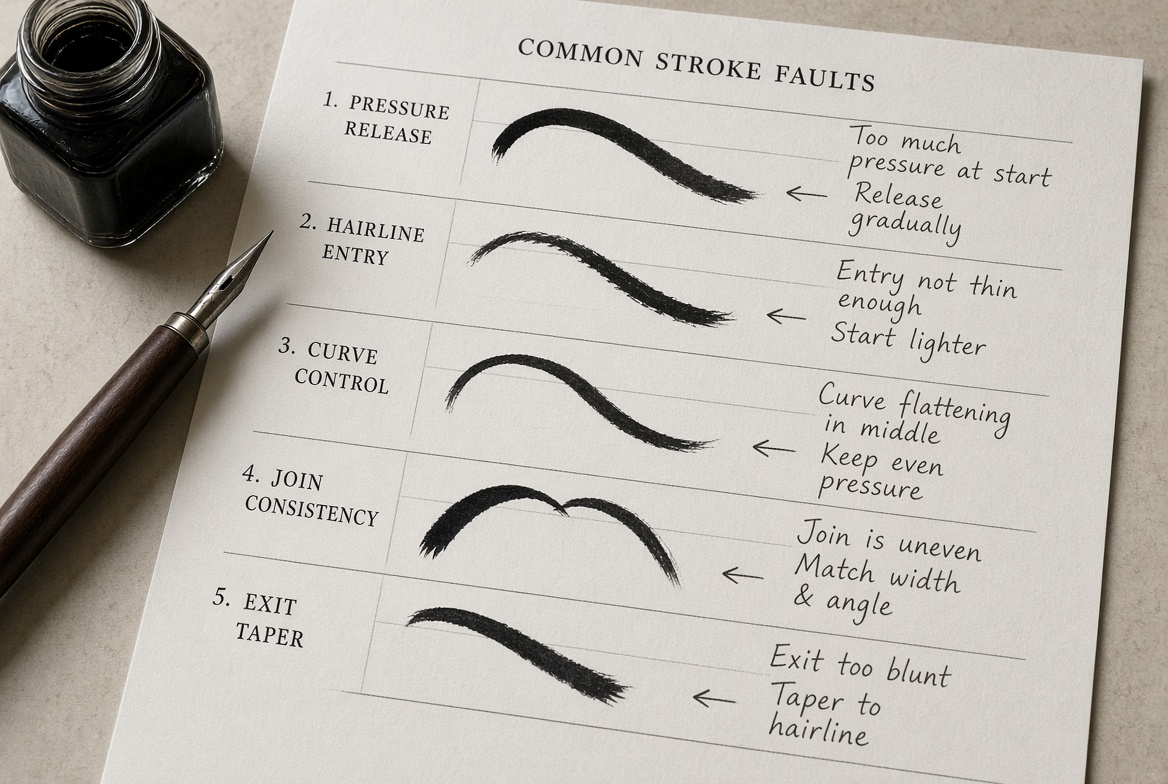
You fill ruled sheets with repeated strokes, then compare them against a fault sheet that marks pressure dumps, blunt exits, and flattened curves. The goal is a hand that can produce the same stroke ten times with only minor variation.
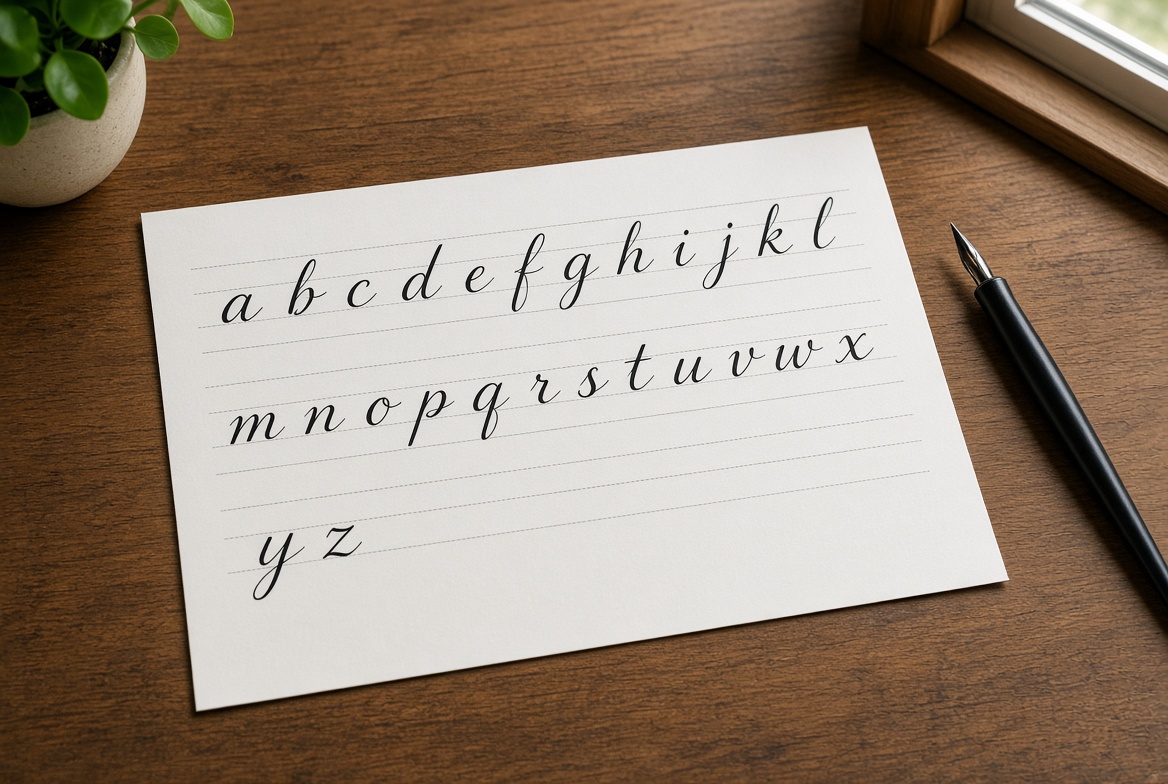
Lowercase calligraphy alphabet practice sheet with pointed pen

Core forms · Sessions 45–70 min

02 — Minuscule forms

Lowercase letters built from the strokes practised in the first area. The focus is proportion (x-height, ascenders, descenders) and the limited set of shapes that recur across the alphabet.

What you work on

Groups of related letters (for example, n–m–h–r, or o–c–e–a). Joins that maintain consistent width. Spacing within a word so that the white space feels even. Writing short words rather than isolated letters as soon as basic forms are stable.

How practice works

Construction sheets show each letter broken into numbered strokes. You copy the sequence, then write the letter freehand, then check against a list of common failures (uneven ovals, cramped counters, inconsistent slant).

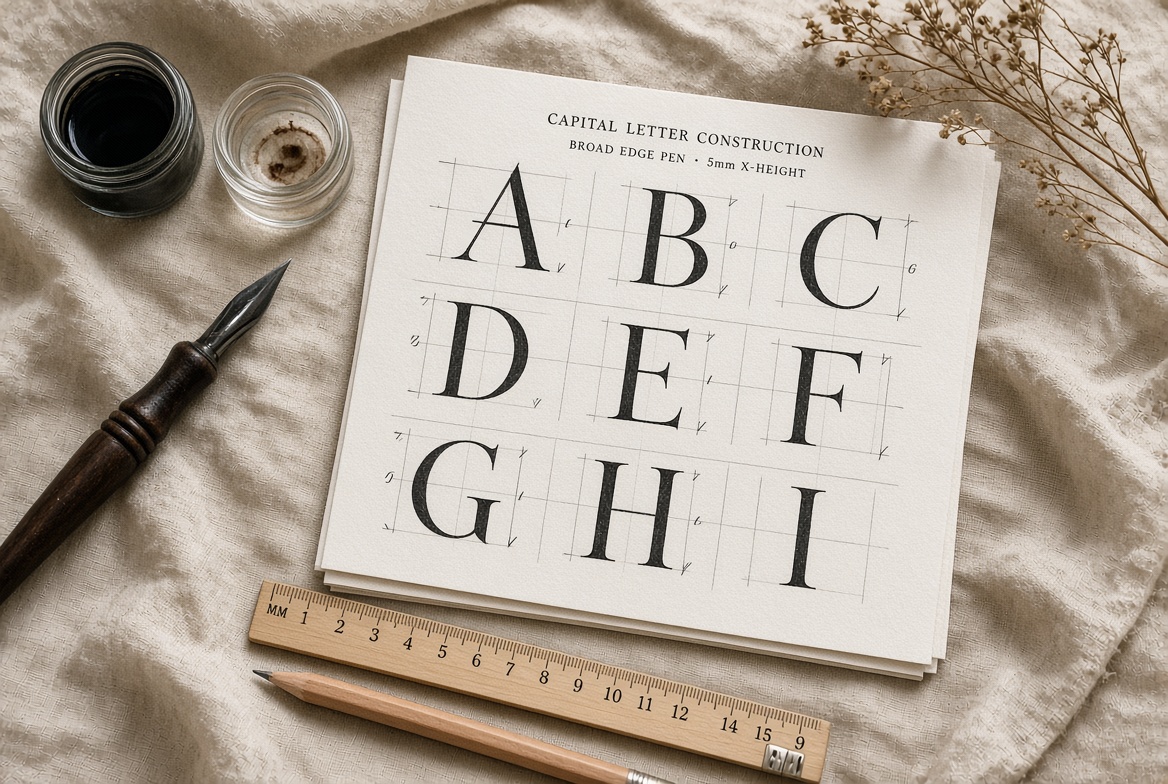
Capital letter construction sheet with proportion grids and broad-edge pen

Core forms · Sessions 45–70 min

03 — Majuscule forms

Capital letters treated as constructions with clear geometric relationships, whether approached with a pointed nib or a broad edge. Proportion grids keep height and width under control.

What you work on

Basic capital skeletons before decoration. Weight distribution so that heavy and light strokes sit correctly. Letters that share structural logic (H–I–L, O–C–G, V–W–A). Simple combinations for titles and short headings.

How practice works

You work from grid-based models, then reduce the guides until you can hold the proportions by eye. Diagnostic notes flag capitals that lean, that are too narrow for their height, or that carry weight in the wrong places.

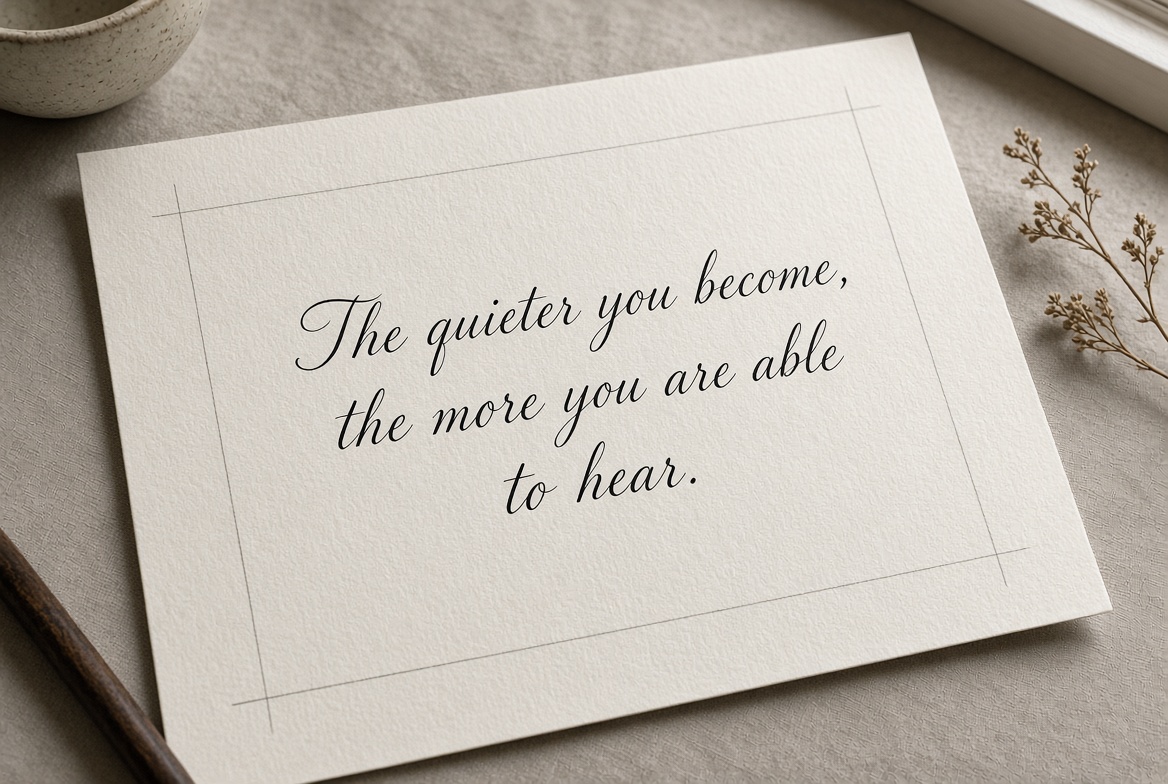
Finished short calligraphy text with careful margins and spacing

Application · Sessions 50–75 min

04 — Spacing and short layouts

Once individual letters are reasonably stable, the next difficulty is the space between them and the arrangement of a short text on a page. This area treats layout as a measurable skill, not a matter of taste alone.

What you work on

Word spacing that matches the average counter of the letters. Line spacing that leaves the text readable without floating. Margins and a simple text block. Writing a short phrase (one to three lines) so that the overall texture is even.

How practice works

You plan a small layout in pencil, write it in ink, then assess it with a checklist: even colour, consistent baseline, margins that do not crowd the edge. Failed layouts are kept as reference, not discarded.

Annotated sheet of common stroke faults for self-diagnosis

Diagnostic · Sessions 30–50 min

05 — Fault diagnosis

A dedicated set of comparison sheets that name the most frequent errors in stroke and letter work. Used throughout the other areas, and also as a standalone review when practice feels stuck.

What you work on

Pressure dumps at the start of a stroke. Entries that are too thick. Curves that flatten mid-way. Joins that do not match width or angle. Exits that end bluntly instead of tapering. Uneven slant across a word.

How practice works

You place your own sheet beside the diagnostic models and mark which faults appear. Correction drills target one fault at a time. The aim is not perfection, but the ability to see a problem clearly enough to adjust the next attempt.

Materials and access

Practice sheets and diagnostic checklists are provided as downloadable materials after correspondence with the studio. A pointed or broad-edge nib, suitable ink, and smooth practice paper are the learner’s responsibility. The studio does not sell tools as a primary activity and does not endorse specific brands.

If you are unsure where to begin, write with a short description of your current experience. We can point you to the relevant practice area. We do not assess work for commercial readiness or place learners with clients.